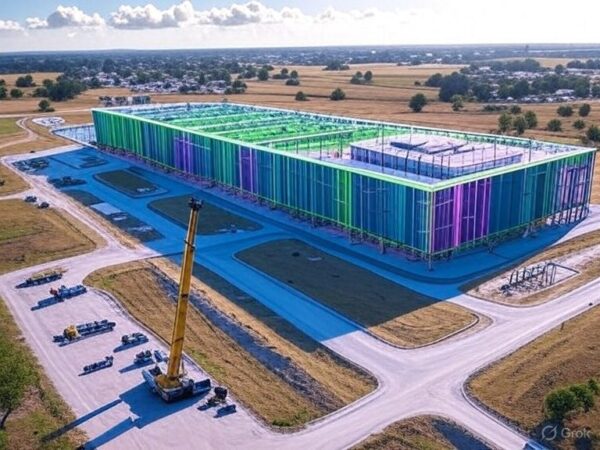
Data center construction is surging as AI giants and society as a whole push the limits of AI usage. But where are these new data centers going and how will ‘host’ towns be affected? [Last updated July 19, 2025]
The bottom line
A data center coming to your town means big tax benefits for your community. But is that enough to balance out the economical and environmental impacts?
The global boom in data center construction
Construction projects worldwide increased sixfold in the first half of 2024, with 78 projects totaling over an estimated $9 billion (with actual costs likely higher; excludes China). In the US, tech giants continue to drive the massive buildouts: Microsoft will spend $80 billion on data centers in 2025 while Meta’s $10 billion Louisiana facility began site work in December 2024. (Meta expenditure marks the largest private investment in Louisiana’s state history.)
Top 5 Active Construction Projects (Under Construction in 2025):
- Meta Louisiana Campus – $10 billion (Monroe, Louisiana) – Site work started December 2024, construction through 2030, 4 million sq ft
- Google Fort Wayne Campus – $2 billion (Indiana) – Construction ongoing since April 2024, 700+ acres for cloud and AI infrastructure
- Meta Cheyenne Campus (Wyoming) – Under construction by Fortis Construction, employing 1,000 workers during peak construction
- Edged Energy Columbus Facility – $250 million (Ohio) – 210,000 sq ft facility scheduled to open July 2025
- Microsoft Mount Pleasant Campus – $1 billion (Wisconsin) – 315 acres, completion targeted for end of 2025
Top 5 Planned/Announced Projects (2025-2028):
- Stargate Initiative – $500 billion potential – OpenAI, SoftBank, Oracle partnership planning 10-20 data centers across US
- Amazon Ohio Expansion – $10 billion – Sunbury campus construction scheduled to begin in 2028, completion by 2034
- EdgeCore Virginia Campus – 1.1 GW capacity – Planned 3.9 million sq ft facility on 697 acres in Louisa County
- Atlas Development Georgia – $17 billion – “Project Sail” 13-building campus spanning 4.9 million sq ft across 832 acres
- Amazon Pennsylvania AI Campuses – $20 billion – Multiple sites planned for Salem Township and Falls Township
Major International Projects:
China: Aggressive Buildout, Mixed Transparency
Note: Data sourcing on Chinese projects can be challenging due to different reporting standards and state involvement, but the scale cannot be ignored.
- Market size: $47.23 billion in 2024, projected to reach $97.30 billion by 2030 (12.8% CAGR)
- Over 500 new data center projects announced in 2023-2024, with 150+ completed by end of 2024
- Alibaba investing $50+ billion in cloud/AI infrastructure over next 3 years
- ByteDance planning $20 billion in GPUs and data centers
- China Telecom’s Hohhot facility: 1 million square meters, $3 billion, serving Alibaba/Tencent/Baidu
- Environmental focus: Alibaba’s Zhangbei facility uses liquid cooling technology and renewable energy as part of carbon neutrality goals by 2030
- Challenge: Significant underutilization – many facilities built for political reasons rather than demand, with only ~10% of companies still actively training large models
Other Global Projects:
- Germany/UK: Major expansion in Frankfurt, Berlin, and multiple UK facilities
- Malaysia: NTT’s 290 MW campus in Johor Bahru (6 buildings, 70 acres)
- Australia: Goodman Group raising $2.6 billion for global data center network expansion
Prime destinations for data center projects:
Prime destinations for data center projects include the US, where 42% of spending occurs in Virginia and 28% in Texas, and China, which is implementing a national strategy with 8 computing hubs and 10 data center clusters by 2025. Global expansion features major projects in Germany, the UK, Malaysia, Australia, and coordinated buildouts across Asia-Pacific. These locations are favored due to cheap land, available power, favorable regulations, and, in China’s case, strategic national infrastructure development (channeling demand from eastern cities to western regions).

Challenges and Delays
$64 billion in projects across the US face delays due to local resistance, creating both increased demand for alternative sites and complex legal challenges. Communities are pushing back against data centers due to concerns over power grid strain, water usage, noise pollution, and minimal job creation relative to their massive resource consumption. This resistance is forcing developers to seek more remote locations and invest heavily in community relations and infrastructure improvements to secure approvals.
Economic benefits: the tax windfall [US data]
Data centers represent massive capital investments ranging from $50 million to over $1 billion per facility, with a single $1 billion data center generating the same economic impact as a 1,700-job corporate headquarters. The ripple effects are substantial – each direct job in the data center industry supports more than six jobs elsewhere in the US economy, driving increased employment across construction, telecommunications, professional services, and other sectors.
Additionally, the data center industry’s total tax contribution to governments at the federal, state, and local level increased from $66.2 billion in 2017 to $99.6 billion in 2021. This translates to funding for essential services like public education, maintenance of infrastructure such as roads and public transportation, and public health.
Loudoun County, Virginia, saw data center tax revenue surge 170% to $582 million between 2021-2023, while AWS alone contributed $54.2 million in property taxes, fees and other payments to Eastern Oregon in 2024.
Key Economic Impacts Include:
- Job Growth: Direct employment in the US data center industry grew by over 17% from 2017 to 2021, compared to 2% employment growth for the United States overall.
- Income Surge: Labor income earned directly from the data center industry grew by 74% between 2017 and 2021, rising from $43 billion to $75 billion.
- GDP Contribution: The industry’s total annual impact on US value added (contribution to GDP) grew from $355 billion in 2017 to $486 billion in 2021, a 37% increase.
- Diverse Opportunities: Over 40% of the data center industry’s workforce are high school graduates or have some post-secondary training or associate degree, and nearly 60% have a four-year college degree or higher.
Employment Reality: Massive Investment, Modest Job Creation
Even as the AI industry promises significant economic growth nationwide through data center projects, local communities often see minimal long-term job creation despite massive infrastructure demands. With more data centers projects in the pipeline, jobs are definitely increasing:
In the US, the data center industry contributed 4.7 million jobs to the U.S. economy in 2023, a 60% increase from 2017. The U.S. Bureau of Labor Statistics projects a 9% growth rate for electrical engineering jobs between 2023-2033, more than double the average growth rate for all occupations. Each job created in the sector has the potential to create 7.4 additional jobs economy-wide.
Globally, the data center workforce expected to grow from 2 million people in 2019 to 2.3 million by 2025, with the industry as a whole needing to hire 300,000 more staff by 2025 for the “safe operation” of data centers. 58% of global data center operators faced difficulties sourcing talent for open roles
Employment Realities
- Loudoun County, Virginia, has 199 data centers providing 12,000+ jobs, averaging about 60 employees per facility
- Microsoft’s Boydton campus has provided 300 jobs across the region
- Meta Louisiana’s facility promises 500+ projected, full-time jobs
- 77% of data center professionals saw salary increases in 2023, though median compensation rates remained identical to the previous year
- In Virginia, the average data center technician salary ranges from $40K-$73K – Meta promises $105K for its 500 permanent positions
A developing skill crisis
The data center industry faces a “skill crisis” driven by overly stringent hiring practices and an impending wave of retirements. By setting high entry barriers, such as requiring university degrees for roles that could be filled through practical experience or targeted training, the industry excludes capable candidates, exacerbating talent shortages.
Concurrently, the “silver tsunami” looms as seasoned professionals from the late 1990s internet boom near retirement, threatening to deplete institutional knowledge and skilled labor. This dual challenge risks stalling growth unless the industry embraces more inclusive hiring and proactive knowledge transfer.
[Infographic coming]
Water demands of data centers
Data centers consume massive amounts of water primarily for cooling their heat-generating servers, which have to maintain temperatures between 68-82 degrees Fahrenheit to operate efficiently. Some facilities also use water for humidification systems and fire suppression. About 57% of data center cooling water comes from potable drinking water sources, which become unsuitable for human consumption after chemical treatment to prevent corrosion and bacterial growth. In the US, data centers consume 1.7 billion liters of water daily.
Daily Consumption:
- Average data center uses 300,000 gallons/day (equivalent to 100,000 homes).
- Large facilities may take up to 5 million gallons/day.
Trends:
- Two-thirds of new US data centers since 2022 are in water-stressed areas
- The concerning level of water consumption by data centers in Arizona has caused officials to limit home construction to preserve ground water.
One of the major issues facing host towns is the ability of big tech companies to negotiate better water rates than residents.
Electricity impact: rising costs projected
Data center energy consumption has tripled over the last decade and projections indicate it could double or triple again by 2028, potentially accounting for 9% of total US power consumption by 2030. As one of the hot spots for new data center construction, the State of Virginia recently released a study that estimated rate increases for Virginia residents:
- Residential bills to increase by $14 to $37/month by 2040 (in constant/real dollars, independent of inflation).
- Energy demand could double within 10 years, driven primarily by data centers.
- Infrastructure requirements: Virginia would need to build a large natural gas plant roughly every 1.5 years to meet demand.
Previously established data center regions like Arizona and Oregon are already taking up significant percentages of each state’s total grid power (7.4% in Arizona, 11.4% in Oregon). In the heart of Silicon Valley’s Santa Clara, 55 data centers operating, using 60% of the city’s electrical power.
While the idea is to have the AI companies pay for the utility infrastructure, data centers are growing so fast that residents may temporarily overpay based on outdated rate projections until utilities adjust their cost allocation models

Part of Meta’s plan for the Louisiana project is to match electricity costs with 100% clean and renewable energy while providing $200 million in local infrastructure improvements. Their tax contribution to the municipalities is expected to be $800 million over the 30-year PILOT agreement term.
In return, Meta receives a 20-year sales tax exemption on data center equipment, pays 20-40% of normal property taxes through PILOT agreements (dropping to 20% once they hit $10B investment and 500 jobs). They’ll also benefit from Louisiana’s reduced corporate tax rate of 5.5%. All of this is contingent on Meta maintaining at least 500 permanent, full-time employees.
Physical footprint: massive scale
Data centers require massive land footprints, with a minimum of 40 acres needed for feasible sites. Meta’s proposed Louisiana facility demonstrates this scale at 4 million square feet across 92 acres. OpenAI’s ambitious Stargate project plans an unprecedented 30 million square feet spanning approximately 700 acres—making it 4.6 times larger than the Pentagon.
Environmental impacts
Data center construction destroys natural habitats through extensive land clearing that removes vegetation and displaces wildlife. The construction process contributes to soil erosion and water pollution while causing habitat fragmentation and eliminating critical food sources and shelter for species that depend on these interconnected ecosystems for survival.
Examples:
- The proposed Prince William County data center in Virginia requires rezoning 2,100 acres (next to the Manassas National Battlefield park) which is currently zoned for agriculture and environmental use. Over 30 organizations including the National Park Service warn that impacts “could be irreversible.” Kathy Kulick, who heads a coalition of over 50 county residents opposed to the project, warned that some landowners are selling quickly, potentially undermining the region’s comprehensive planning goals: “If you can build it here — next to a national park and on a drinking water reservoir — then it will go everywhere.”
- In Arizona, growing concerns over water scarcity have led to strict limits on new construction, including data centers, as the state grapples with a 22-year megadrought and dwindling Colorado River supplies. Governor Katie Hobbs recently imposed restrictions around Phoenix to curb groundwater depletion, a move spurred by local resistance to projects like Google’s Mesa facility, which secured 1 million gallons of water daily for cooling. Residents and officials, including Mesa City Council member Jenn Duff, have voiced opposition, arguing that these water-intensive developments threaten community access and exacerbate drought conditions, fueling a broader pushback against big tech’s expansion in water-stressed regions.
Mitigation Strategies
Both Microsoft and Meta are heavily invested in carbon offset strategies. Microsoft was the biggest buyer of carbon removal credits in 2024, with an $800M deal and a commitment to become carbon negative by 2030. [Microsoft’s emissions have increased 30% since 2020 due to AI expansion.] Meta, who has committed to net zero emissions by 2030, has secured long-term carbon credit deals for forest conservation and joined coalitions to purchase up to 20 million tons of carbon credits.
Beyond corporate commitments, emerging technologies like underwater data centers, utilizing seawater cooling to reduce energy consumption by up to 30%, and liquid cooling systems in facilities like Alibaba’s Zhangbei center are gaining traction. Additionally, China’s push for renewable energy integration, targeting 80% green electricity in new hubs, and advanced energy-efficient designs aim to lower the power usage effectiveness (PUE) to below 1.5 by 2025, reflecting a commitment to greener infrastructure amid rapid expansion.
AI Data Center Infrastructure: mixed results
While data centers can catalyze significant upgrades to community infrastructure, their massive power and water requirements can strain existing systems in ways that require careful planning and substantial investment.
✅ Benefits:
- Upgrades to roads, water, sewer, fiber, electrical infrastructure
- Minimal traffic impact (less than 100 employees per site)
- Can revitalize abandoned sites
❌ Strains:
- Outpaces local sewer network capacity
- Pressure on water supply and infrastructure
- Massive power demands can stress electrical grid capacity, requiring costly upgrades
- Ecological and Resource Pressure
The future
Global data center capacity is expected to grow 15% annually through 2027, presenting communities with a fundamental trade-off: data centers deliver unprecedented tax revenue and economic opportunities, but residents often bear the cost through higher utility bills, strained infrastructure, and environmental impacts.
The key question facing communities isn’t whether data centers will continue expanding—it’s how well local leaders can negotiate agreements so that the downsides are minimized and the economic benefits outweigh the impact on communities.
The expansion won’t slow down anytime soon, as Anthropic’s CEO, Dario Amodei, noted recently about the breathtaking pace of construction: if we stop building now, ‘China would just beat us.’ For local communities, this competitive pressure means the next wave of construction is inevitable, making it even more critical that towns secure favorable agreements.
Creator’s Note: This piece was co-created with Claude.ai and Grok through collaborative research and writing. I guided the direction, edited the final piece, and verified all sources, which are linked below. Notably, unlike the tech giants building these facilities, Anthropic operates through cloud partnerships, outsourcing their infrastructure footprint rather than constructing massive data centers themselves. The hero image was created using my prompts in Grok.
Additional Data sources:
- New Data Center Developments: March 2025
- New Data Center Developments: February 2025
- 2025 Big Tech Data Center Construction Update
- Data center construction projects underway in 2025
- 2024’s Biggest Data Center Construction Stories: A Year in Review
- National Impact Study 2023
- DOE Report Evaluating Increased Electricity Demand from Data Centers
- Thirsty For Power and Water, AI-Crunching Data Centers Sprout Across The West
- Data Centers Draining Resources in Water-Stressed Communities
- AI Data Center Growth Deepens Water Security Concerns
- Virginia Data Center Study: Electric Infrastructure and Customer Rate Impacts
- Santa Clara Data Centers Hit Max Energy Capacity
- NPJ Data Centre Water Consumption
- How Data Center Demand Is Shaping Real Estate Markets
- Waste, Water…What Else? Tackling Environmental Woes for U.S. Data Centers
- Data Center Decisions Could Have Big Land Use Impacts
- Data Centers Consume Millions of Gallons of Arizona Water Daily